We use cookies to make your experience better. To comply with the new e-Privacy directive, we need to ask for your consent to set the cookies. Learn more.


At Home with Siddhant Bothra

This series offers a closer look at the lives and practices of contemporary creatives, tracing the references, routines, and cultural touchstones that inform their work. Here, we visit Siddhant Bothra - designer, founder of Home of Chirmi, recipient of the Red Dot Design Award and two German Design Awards, and one of Architectural Digest's Top 25 New Wave Designers in South Asia. Equal parts storyteller and systems thinker, his practice is informed by cinema, engineering, observation, and an enduring fascination with the objects that surround us.

All images courtesy Home of Chirmi
Siddhant’s favourite corner at home - the den, where he retreats to unwind over video games.
I do not really separate life from design. For me, the two have always existed together in one continuous stream of observation, absorption and realization. Design was never alate discovery or a calculated career choice. It felt instinctive from the very beginning.
I was born in the same year my parents founded Chirmi Overseas in 1996. By 1999, they had started exhibiting globally for the export market, and although my memories fromthose years exist only in fragments, the atmosphere of making stayed with me. Materials, prototypes, exhibitions, logistics, failures, experimentation, and the constant effort to bring ideas into the physical world became part of my subconscious long before I formally understood design itself.

Interior Designer: Vartika Jangid; Architect: Sheetal Tater; Photographer: Vedant Sharma
A glimpse into Siddhant’s workstation, his preferred space for creation and contemplation.
At the age of seven, I already knew I wanted to become a product designer and storyteller. My uncle, architect Sheetal Tater, played a major role in shaping that inclination. During my childhood, he would introduce me to architecture and industrial design in a way that felt exciting and cinematic rather than technical. Later, spending two years interning under legendary designer Ayush Kasliwal during high school became another major turning point for me.

Siddhant’s residence. Courtesy Home of Chirmi
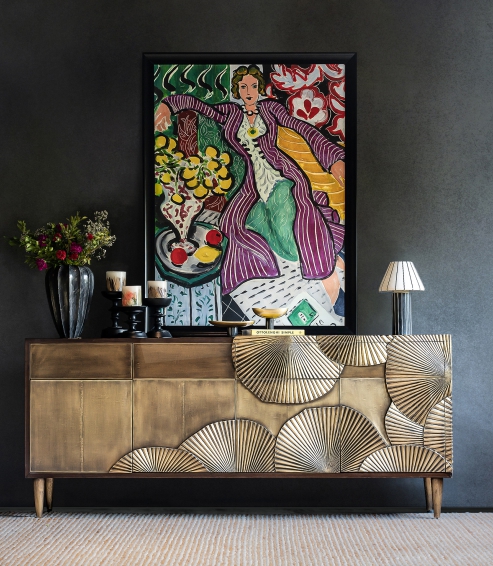
Today, my process remains intuitive, but never unstructured. I see design as a subconscious collection of everything I keep absorbing from life. While designing the products for my residence, there were many personal influences from my favourite films and comic characters. Yachts and boats are something I have always been obsessed with - many of the furniture shapes, edges, and curves are inspired by them.

The bookcase was my favourite piece to make. I have always visited libraries in every country I have travelled to, especially those in Switzerland and Austria. For me, a library is a place that holds countless stories. Since childhood, I have been collecting comics, art, and games based on Robin Hood, The Phantom, and Jack Sparrow. So, on the door panels of the library, I had these characters hand-painted by artisans. The frame of the bookcase is inspired by the ropes of pirate ships. The materials used in this piece are ash wood, wenge, teak, and linen. We built the entire piece in our studio and assembled it on site.

Cinema continues to be one of the strongest influences on my work. I believe design should not exist only to solve problems. It should also create wonder. It should make people ask questions. It should make people feel something.

That same curiosity appears in the smallest details that catch my attention in everyday life. A perfectly designed fork for eating spaghetti can genuinely excite me. At the same time, I am equally fascinated by products that reveal hidden layers over time. Details that are not obvious at first glance but slowly unfold through prolonged interaction.
This layered approach also defines my own work. Many of my pieces contain motifs, parallax views, or subtle visual references that remain intentionally understated. Once an object leaves my hands, I believe it belongs to the person living with it. They are free to ignore those details, reinterpret them, or assign completely new meanings to them.

Among all the pieces I have designed so far, the Axis of Void chair remains my favourite. The idea came to me almost involuntarily while half asleep. I remember waking up and immediately rushing to my workstation to give the thought physical form before it disappeared. The concept of “void” itself has remained a recurring theme in my work. I believe meaning is shaped not only by what exists, but also by what does not.

My understanding of craftsmanship is perhaps less romantic than that of many contemporary designers. While I deeply respect traditional craft, I also embrace technology and machines as extensions of the creative process. For me, craftsmanship lies in the faithful realization of an idea, whether shaped by hand or machine.
I've long since moved beyond labels like minimalism or maximalism. What draws me most to contemporary design is its spirit of constant reinvention. And perhaps that is exactly the kind of reaction I hope my own work creates.
“Oh wow. Why? Oh, I see. But why? Oh, now I get it. But why?”